

You may have noticed our fresh layout – it reflects the recent formal adoption of the Southern African Wildlife College (SAWC) Strategy 2030, approved by the Board of Directors on 23 April 2025, and the consolidation of two of our newsletters.
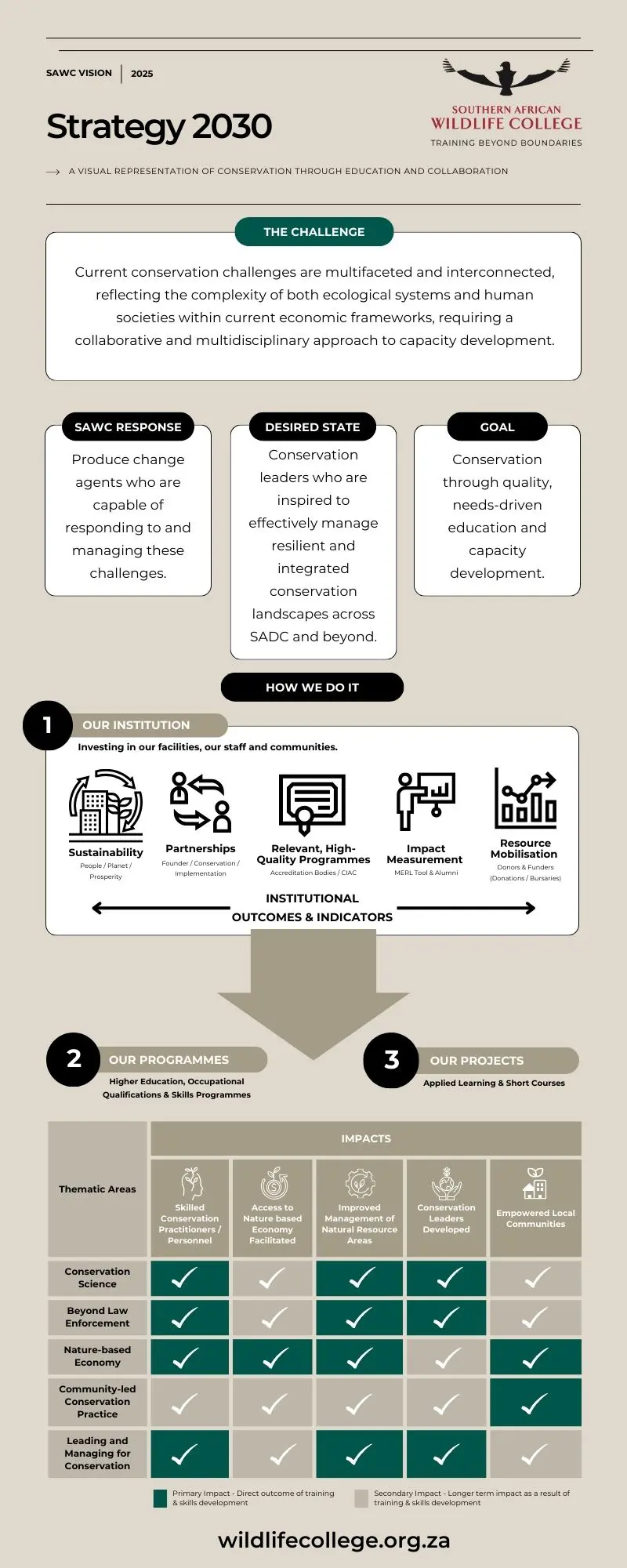
The approved strategy will assist us in meeting our long-term goal of ensuring our students (change agents) contribute to effective sustainable resource management through relevant and needs-based quality education, training and skills development, supported by research and technology.
In developing our new strategy, extensive stakeholder engagement was conducted to assess training and capacity development needs. Our stakeholders’ invaluable feedback helped us to shape a thematic approach to service delivery, optimising human resources, and fostering collaboration. This approach further strengthens the SAWC’s inter-departmental coordination and delivery through a dynamic, matrix-based model – enhancing efficiency, resource sharing, and synergy across training interventions.
A theory of change exercise was subsequently conducted to provide a clear and structured framework for the SAWC’s operations and programme delivery. The ultimate goal for Strategy 2030 is Conservation Impact through Quality needs-driven Education. Focus areas include Institutional Sustainability; Collaborative Partnerships for improved engagement, development of relevant programmes and research; Thematic Areas of Programme Delivery in priority thematic areas that the SAWC has identified in collaboration with its stakeholders; Improved Quality in Training and Capacity Building; and Community Empowerment by embracing a people-centred, rights-based approach. Innovation is at the heart of how we test new ideas and technologies and conduct applied research.
Five key, inter-connected thematic areas emerged as the main conservation priorities for our institution to invest in and support through the provision of capacity development:
- Conservation Science (Biodiversity and Environmental) led by newly appointed Wendy Collinson
- Protected Area Integrity: Beyond Law Enforcement led by Mr Jeremy Hancock
- Community-Led Conservation Practices
- Nature-based Economy co-championed by Dr Thabang Teffo
- Leading and Managing in Conservation – which is cross cutting.
Our Learning and Teaching Department remains central, with three pillars:
- Council on Higher Education (CHE), overseen by Dr Kudakwashe Musengi
- Vocational/Occupational Training (QCTO/SETA’s) (Qualifications and Skills Programme) led by Mr Christopher Kafoteka
- Short Courses & Applied Projects (R&D) – which are cross cutting
Wendy succeeds Dr Lindy Thompson, who concluded her tenure in April to pursue vulture research with the Endangered Wildlife Trust (EWT). Originally from the UK, Wendy brings a wealth of experience as an accomplished conservationist, educator, and development practitioner with a deep commitment to inclusive, evidence-based approaches to sustainability and biodiversity protection. Wendy holds a BEd (Hons) from Bedford College of Higher Education and a Masters degree in Zoology from Rhodes University.

Apart from founding EWT’s pioneering Wildlife and Transport Programme whilst developing protocols in road and rail ecology, Wendy has also managed community education through the Future Rangers Programme in Hoedspruit. Interestingly she has also specialised in integrating Gender Equality, Disability, and Social Inclusion (GEDSI) into clean energy and environmental initiatives contributing her expertise to international dialogues and policy development.
With credentials in Zoology, inclusive and holistic development, and years of field research across Africa and beyond, Wendy is certainly poised to strengthen our science and infrastructure focus.
In other news, we’ve merged The Bateleur and Wildlife Guardian News into a single bimonthly publication – The Bateleur – to deliver concise, high impact stories that respect your time. We welcome your feedback on how to make this publication even more relevant and engaging.
Meanwhile, the SAWC leadership has been busy with critical engagements. CEO, Theresa Sowry, and Executive Manager for Marketing, Fundraising and Media Relations, Jeanné Poultney, recently concluded their annual European trip, cultivating partnerships and securing vital funding. Highlights included:
- Presenting Strategy 2030 to donors in the Netherlands, the UK, Switzerland and Italy
- Signing a collaboration agreement with the University of Parma (Università degli Studi di Parma) to facilitate research projects and student exchanges
- Joining forces with Friends of African Wildlife in Zurich for a successful “Be Part of It” fundraising gala.
- Engaging with long standing donors on collective priorities.
There is no doubt that the challenges facing conservation today are complex and deeply interconnected, reflecting the intricate relationship between ecological systems and human societies. Tackling these issues demands a collaborative, multidisciplinary approach that prioritises skills and capacity development through comprehensive, integrated, and inclusive strategies.
As such, we remain deeply grateful to our global community – your collaborations, insights and generosity empower the SAWC to shape the conservation leaders of tomorrow.