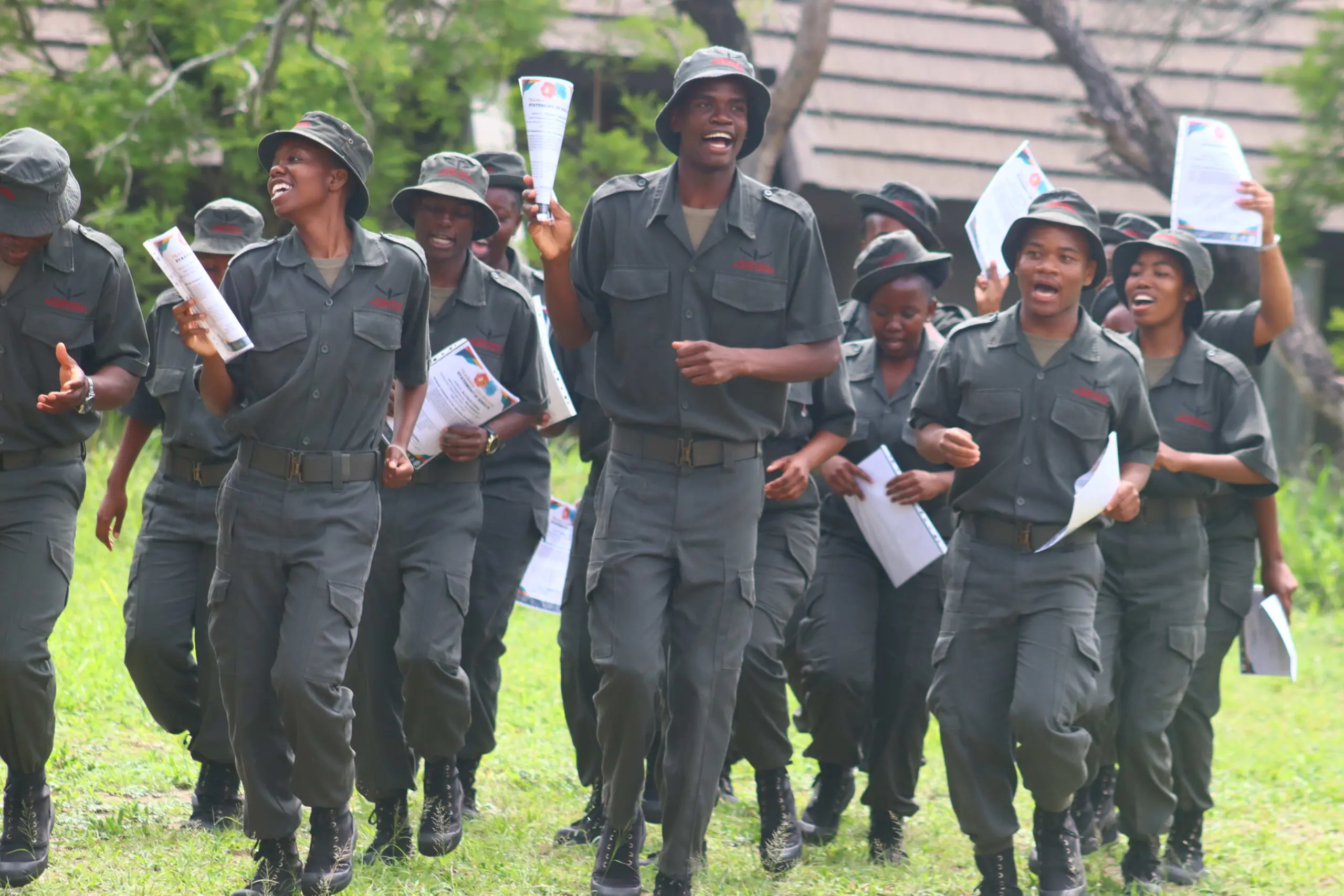
By Dr Kudakwashe Musengi Over two action-packed weeks, our Natural Resource Management Diploma students stepped out of the online classroom and into the real world of conservation, community engagement, and environmental education. These practical activities formed a vital part of their experiential learning, giving them the opportunity to apply their knowledge, develop leadership skills, and experience...Read More
By Christopher Kafoteka National Certificate: Natural Resource Management, Terrestrial (NQF Level 5) We are delighted to share the outstanding achievements of 26 students who successfully completed the one-year occupational qualification in Protected Area Management, completing the National Certificate in Natural Resource Management, Terrestrial (NQF Level 5). Graduates were equipped with the knowledge, skills, and attitudes required...Read More
The celebrations began on 3 December with the Student Dinner – an evening of good food, laughter, and shared stories that set the tone for the days to follow. This year’s theme, Learn, Grow, Collaborate and Achieve, invited reflection, but the atmosphere was one of joy and celebration.Students took full advantage of the moment, showcasing...Read More
By: Pieter NelThe Scientific Mandate for Professional HerdingThe Southern African Wildlife College (SAWC) Herding Academy’s role in the Herding and supervised managed herds, has been validated by a four-year case study published by Mudongo et al. (2025). This paper serves as a scientific mandate for our approach, proving that strategic management offers clear economic superiority...Read More
The Southern African Wildlife College (SAWC) has an opportunity for 10 candidates to complete an online Bushwise Nature Site Guide – Theory NQF 2 course. Following successful competition of the online course, two (2) scholarships will be awarded for the six-month Bushwise International Field Guide Course, which will take place at the SAWC.IMPORTANT DATES &...Read More
Welcome to the latest issue of The Bateleur, where we continue to bring our new SAWC Strategy 2030 to life through the powerful stories unfolding across our campus and beyond.In this issue, we shine a light on the incredible people at the heart of our mission. From the courageous rangers who go Beyond Law Enforcement to protect Africa’s wild spaces,...Read More
Investigating the Effectiveness of Reed Beds in Improving Wastewater Quality Reed beds are essentially natural filtration systems, using wetland plants and soil to treat wastewater in a contained environment. At the Southern African Wildlife College (SAWC), this system is more than a compliance measure; it is a research opportunity. The reed bed is being studied...Read More
On 20 September 2025, the Southern African Wildlife College (SAWC) hosted its third consecutive Wildlife Ranger Challenge (WRC) Race Day as a regional hub, joining more than 170 teams from across Africa in this continent-wide celebration of rangers. Now in its sixth year of participation, the SAWC team once again represented the College with pride. The...Read More
Written by the Makuleke Landscape Restoration Project Team This is our story – the story of the Makuleke community. Our deep love for this land, which fuelled our successful land restitution process, now guides our journey of landscape restoration. We are transforming a top-down conservation approach into a true grassroots movement, proving that our collective ownership...Read More
The TLC programme, an initiative of Leadership for Conservation in Africa (LCA), is supported by the Howard G. Buffett Foundation and implemented with partners including the International Union for Conservation of Nature (IUCN), Ugandan Wildlife Authority (UWA), Wildlife Conservation Society (WCS), and Friends of Education Africa (FEA). This first-of-its-kind initiative aims to develop a continent-wide...Read More