Written by Sboniso Ryan Phakathi
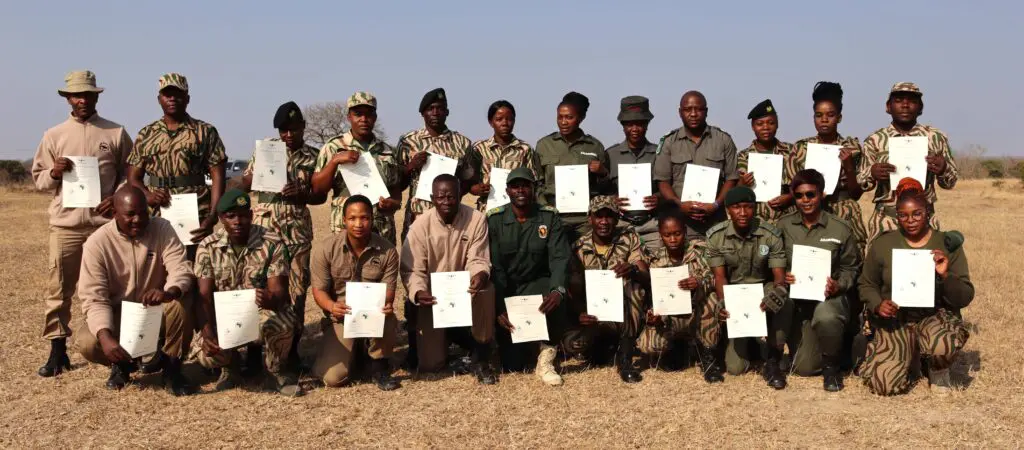
Training field rangers in human rights, safeguards, and trust building in conservation, is both a timely and complex undertaking. In regions like Southern Africa, where conservation landscapes overlap with the lived realities of Indigenous Peoples and Local Communities, rangers are required to navigate not only ecological challenges but also social, cultural, and political dynamics. The recent training delivered in August to 22 conservation students from Botswana, Namibia, Zimbabwe, and Zambia highlights both the difficulties and opportunities inherent in this work.
This five-day short learning course is part of a broader programme aimed at enabling dynamic and progressive Field Ranger training, supported by the Durrell Institute of Conservation and Ecology (DICE) and the University of Kent as part of a grant awarded by the Notsew Orm Sands Foundation for conservation capacity building in Southern Africa. At the heart of this course lies the desire to equip rangers and practitioners with both the knowledge and the relational skills to engage communities fairly so conservation can deliver for both people and nature.
From the outset, we wanted to position this training as a deep dive into real stories and real challenges in conservation management practices, rather than focusing on lectures. From managing human-wildlife conflict, exploring the rights and protections for rangers in the workplace, to ensuring that communities have a voice in conservation decisions, the students quickly realised that protecting nature is not only about wildlife. It is also about people, rights, and relationships.
The course required the creation of a safe learning environment so that rangers didn’t feel like the ‘bad guys doing a public good’ whilst creating enough space to discuss ‘taboo subjects’. These ranged from sexual harassment between rangers, shoot-to-kill attacks, physical and sexual violence against indigenous and local peoples, human rights violations in the course of operations, and gender equity. Our andragogic approach made use of: case-based learning, peer-to-peer learning, participatory tools and reflective practice, encouraging students to critically assess their own institutional cultures, biases, and decision-making processes, fostering deeper self-awareness.
Though these approaches were incorporated to help bridge language and experiential gaps, they also made the classroom a space where diverse experiences came alive. Students reflected on their own practices, debated solutions, and even unpacked Free, Prior, and Informed Consent (FPIC) negotiations. For many, this was the first time they explored conservation as deeply social as it is ecological.
This process for the students also unearthed the broader experiences at a systems level and the awareness that Conservation efforts in the Kavango Zambezi Transfrontier Conservation Area (KAZA) region, much like other TFCA’s, are shaped by histories of displacement, resource pressure from growing populations, human-wildlife conflict (seemingly very prevalent), contested land use, and challenges to benefit-sharing. The students’ personal histories and diverse backgrounds, ranging from park rangers to community conservation officers, brought first-hand experiences of these tensions. These experiences took on an additional dimension of complexity when gender equity or mainstreaming are central to a conservation organisation’s strategy, especially in the case of all-female anti-poaching units.
Exploring safeguard policies, which are often articulated at an international level, translating them into daily conservation practice as evidenced by our discussions, is somewhat of a challenge. More especially if the respective organisation’s systems and processes are not enabling. Training then shifted to focus on the skills to operationalise safeguards, for example, by embedding gender inclusion in project design and implementation, and ensuring that grievance redress mechanisms are accessible and trusted.
The experience underscored that teaching human rights in conservation is not about transferring information; it is about transforming mindsets and practices. What emerged was clear: trust is the heartbeat of conservation. Without transparency, fairness, and respect for local knowledge, no project or conservation initiative can be sustainable in the long term. As the conservation sector continues to grapple with contested landscapes and shifting social dynamics, such training programmes show the importance of combining rigorous content with innovative andragogy.