

For conservation to work over the long term, communities need more than a place at the table. They need access to knowledge and practical tools, meaningful opportunities to shape decisions, and partnerships that recognise their experience of living within shared landscapes.
This thinking underpins the work of the Southern African Wildlife College’s (SAWC) Community-led Conservation Practice (CLCP) thematic area, where recent programmes have focused on human–wildlife interaction, environmental education and community governance.
Rethinking human–wildlife interaction in Zimbabwe
From 9 May to 8 June 2026, the SAWC delivered its Community Practice for Human–Wildlife Interaction programme for Akashinga in Zimbabwe. At the heart of the programme was an important shift in perspective: understanding human–wildlife interaction requires looking beyond individual incidents to the wider landscape in which people and wildlife share space.
One practical exercise asked participants to map their community landscapes, identifying features such as grazing areas, water points, dams and rivers. By looking at how people, livestock, natural resources and wildlife use the same landscape, participants could explore where interactions occur, why they happen and where risks may arise.
The aim of the programme was to create a shared language among Akashinga staff, community members and resource users so that they could better understand human–wildlife interaction and coexistence and make more informed decisions to reduce risk. The programme was successfully completed and received very positive participant feedback.
Growing environmental knowledge within communities
Closer to home, CLCP continued its work through the Global Environment Facility (GEF) 6 project, delivering Introduction to Environmental Education (Facilitate Conservation Understanding), National Qualifications Framework (NQF) Level 5 training. The first session, held at Awelani Eco-Lodge from 8–12 June, brought together 19 Environmental Monitors from Bileni, Dovho, Tshikuyu and Mutele B. A second session was delivered to the SAWC’s NQF 5 Natural Resource Management Certificate students from 20–24 July.
Participants explored the principles of environmental education and learnt how to develop and present programmes for school learners, adults and communities. The training also considered protected areas as resources for environmental learning and included practical experience in delivering an interpreted environmental trail.
Importantly, the emphasis was not simply on learning about environmental issues. Participants were equipped to take that knowledge back into their own communities, develop locally relevant environmental education activities and support community action around environmental challenges.
From community input to Governance Guidelines
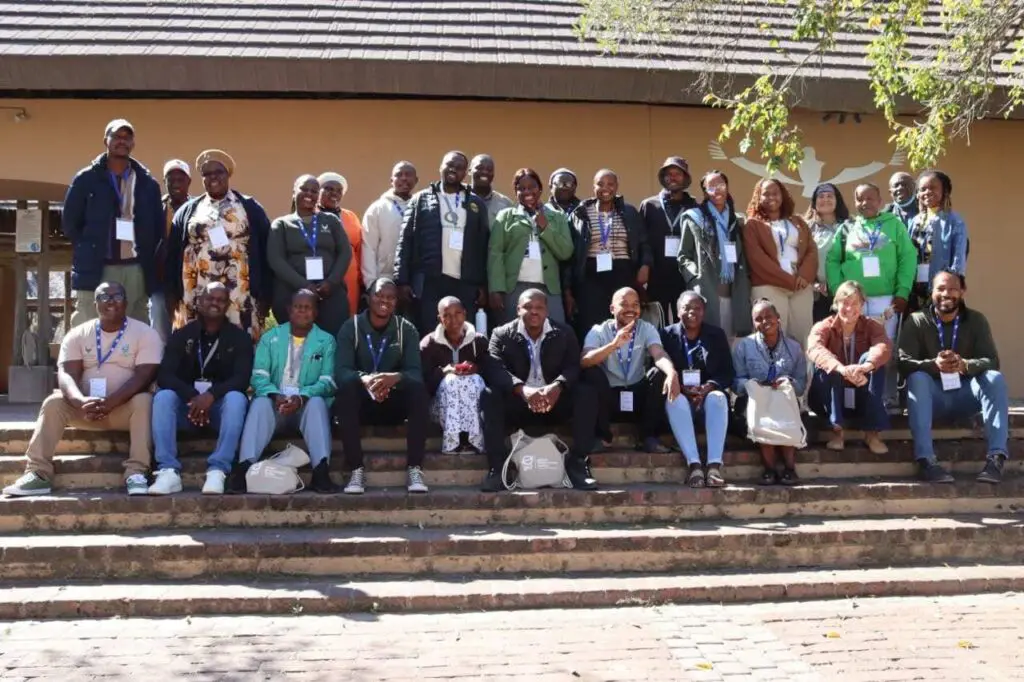
Another important milestone under the Global Environment Facility’s sixth funding cycle (GEF-6) programme came in August with the Governance Guidelines Training and Launch Workshop, hosted at the SAWC from 17–20 August 2026. The four-day process brought together community representatives from the Northern, Central and Southern clusters, alongside conservation, government, law-enforcement and civil-society partners.
Rather than simply launching a document, the workshop focused on putting the guidelines into practice. Community representatives worked through realistic governance scenarios, identified priorities within their own areas and considered how the guidelines could support responses to challenges ranging from human–wildlife conflict and environmental concerns to crime and community safety. Site visits provided further opportunities to see different approaches to governance in practice.
Across the three clusters, a common message emerged: the guidelines should be a practical, community-owned framework, supported by stronger participation, clearer communication and reporting systems, and sustained partnerships with government, conservation organisations and other stakeholders.
Participant feedback following the workshop was encouraging. Of the 20 participants who completed the evaluation, 95% rated the workshop as “very useful” and 100% said they would recommend a similar workshop to other community representatives. All respondents reported that their understanding of fair and transparent community decision-making had improved “a great deal”.
Just as importantly, participants were ready to carry the learning forward: 85% said they were very confident and 15% confident that they could share useful information from the workshop with others in their communities.
The next step is therefore not simply distributing the guidelines. Participants identified follow-up community meetings, further training, accessible materials and continued engagement with conservation and government partners as priorities for moving from learning to implementation.